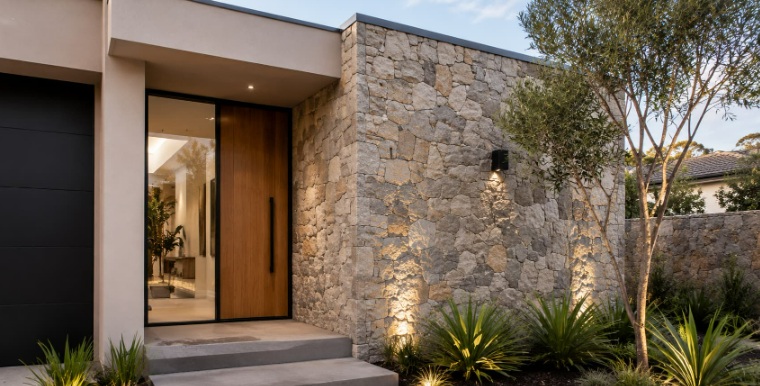
Natural-stone walls are no longer reserved for heritage builds or leafy acreage properties. Across Melbourne and regional Victoria, sandstone pillars greet guests at the gate, slim bluestone ribs frame fireplaces, and travertine panels transform plain façades into textural talking points. If you are weighing up whether to join the trend, this guide separates style inspiration from practical realities.
Why Stone Is Back in Demand
Builders who once defaulted to lightweight panels now field more queries about solid finishes. Three drivers sit behind the shift:
- Visual depth that factory-pressed products struggle to mimic
- A preference for low-tox materials after the engineered-stone silica debate
- Lower energy bills when dense masonry buffers heat swings
Budgets still dictate many decisions, yet the perception that stone is wildly out of reach is fading. Imported split-face options and thinner veneers have nudged the cost closer to premium renders and composite boards.
Choosing the Right Stone for Australian Conditions
Australia’s varied climates mean a stone that thrives in coastal Portsea might crumble inland. Start by matching the deposit’s natural habitat to your postcode. Explore types of exterior cladding options below;
| Stone Type | Strengths on a House | Watch-outs in Victoria |
| Sandstone | Warm tones suit federation updates, easy to shape for curves | High porosity; seal well in the Dandenongs’ heavy rain |
| Bluestone | Dense, reliable against freeze–thaw in the High Country | Dark tone absorbs heat, which can create thermal bridges |
| Travertine | Light colour reduces glare, open pores give rich texture | Needs a bedding system that prevents water tracking inward |
| Granite | Handles bushfire zones, minimal staining from red dirt | Heavy, so check footing capacity on lightweight extensions |
Where the table raises red flags, porosity, thermal load, weight, modern solutions help. Breathing sealers, drained cavity systems and anchors certified under AS 5216 now cover 20 mm veneers through to 40 kg slabs.
Design Moves That Pay Off
Stone can overwhelm if spread across every surface. Architects often isolate three zones that maximise impact without ballooning the bill:
- Entry Axis
Columns or low planter walls lining a path add scale before the front door while keeping upper levels lighter for balance. - Central Hearth
Internal cladding around a fireplace or double-height void offers year-round texture. Indoors, a softer split finish beats a rugged quarry face. - Outdoor Rooms
Pool backdrops and alfresco kitchens cop sunscreen, salt and smoke. Dense stones such as granite or basalt shrug those off better than calcite-rich limestones.
If you plan to connect interiors with outdoor areas, keep grout colour and joint width consistent. Continuity tricks the eye into reading the wall as structural, even when the indoor section is just a 30 mm veneer.
Installation and Upkeep Essentials
Unlike brick ties or direct-stick tiles, vented stone systems need a trade who understands both masonry and waterproofing. Expect four stages:
- Substrate preparation – battens or adjustable rails create the cavity depth
- Waterproof layer – a breathable membrane plus flashings at openings
- Mechanical fixing – stainless hooks or kerf-and-track anchors handle weight
- Pointing and sealing – lime or polymer grout followed by a penetrating sealer
Annual maintenance is light. A low-pressure hose clears dust, and a pH-neutral cleaner lifts tannin marks from nearby timber. Resealing every five to seven years keeps freeze–thaw damage at bay in elevated sites such as the Macedon Ranges. For homeowners keen to compare finishes and fixing systems, Melbourne showrooms that specialise in natural stone cladding can demonstrate how different profiles handle weather and wear.
Safety, Compliance and Sustainability
After flammable aluminium composite panels dominated the news cycle, cladding compliance shot to the top of planning checklists. Stone is inherently non-combustible, yet councils still scrutinise fixings, moisture control and structural loads. The National Construction Code outlines the fire-performance and wind-loading requirements that apply to cladding in each region. Engage an engineer early if your design involves slabs thicker than 40 mm or panels placed more than 10 m above ground.
Quarrying has an environmental footprint, so look for suppliers who publish extraction data, recycle water and offer take-back schemes for off-cuts. Freight often carries a bigger carbon cost than extraction, which means selecting Victorian bluestone over an imported equivalent can cut embodied emissions substantially.
Where Stone Adds Real Value
Property valuers rarely list “stone walls” as a separate line item, yet suburb-record sales often share one trait: a façade or interior feature that photographs well and feels solid under the hand. Beyond aesthetics, stone’s thermal mass can reduce cooling demand during Melbourne’s 40-degree heatwaves, and its durability keeps maintenance crews away for decades. Those savings do not show up in the initial quote but surface in resale conversations when buyers weigh cracked render against a wall that looks untouched after fifteen summers.
A well-chosen stone delivers permanence—both visual and physical—that lighter claddings chase but seldom match. Run the numbers, confirm compliance details and seek quarry-specific advice from your supplier. Get those elements right and the wall you build now will keep turning heads long after many years.