


Most people planning a kit home, granny flat or transportable build spend months on the floor plan and almost no time on what is already growing on the block. That order tends to reverse itself the moment a semi-trailer needs to reverse down a driveway with a mature gum leaning over it.
Site preparation is where prefab builds either run smoothly or quietly blow out. Vegetation is the part that surprises people most, because trees are not simply an obstacle to be cut down on the weekend before delivery. They carry council rules, biosecurity classifications, root systems that interact with slabs and drainage, and in some regions, wildlife protections. Sorting this early is far cheaper than sorting it late.
Work Out Which Trees Actually Have to Go
Start by separating the trees that genuinely conflict with the build from the ones that are just in the general vicinity.
A tree conflicts with your build if it sits inside the slab footprint, sits within the structural root zone of the slab, blocks crane or truck access, overhangs the position of the roofline, or sits in the path of a driveway, service trench or effluent system. Everything else is negotiable, and worth keeping. Established canopy is one of the few things you cannot buy off the shelf later, and it does real work on a hot block by shading walls and reducing the load on your cooling system.
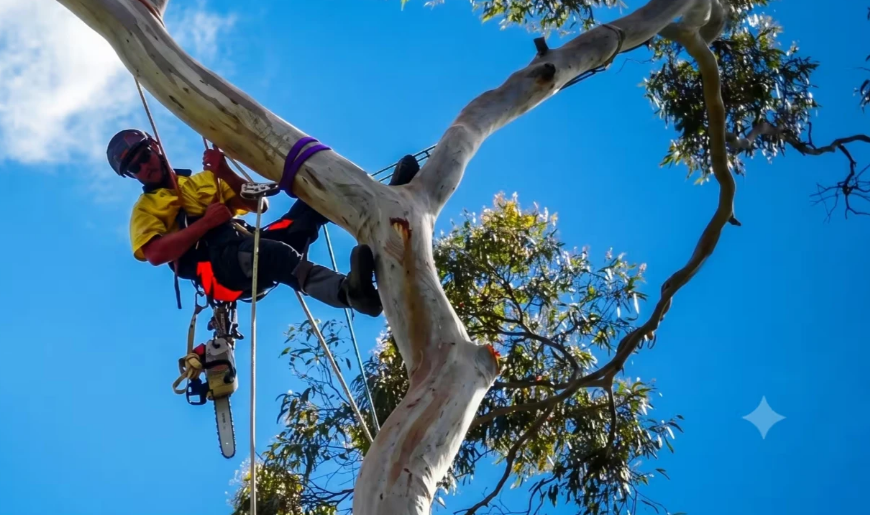
This is also the point to get an arborist’s read rather than your own. A tree that looks healthy can be structurally compromised, and a tree that looks half dead can be perfectly stable. Either way, the assessment matters, because in regional NSW a job like tree removal in Taree is often subject to council approval rather than being a private decision made on your own land. Getting the assessment and the approval pathway sorted before you lock in a delivery date is the difference between a build that starts on schedule and one that sits waiting on paperwork.
Council Approvals Are the Long Pole
Vegetation controls vary enormously between councils, and regional NSW councils in particular tend to have mapped areas where removal or heavy pruning triggers a permit.
MidCoast Council, covering Taree and the wider Manning Valley, runs a vegetation management policy with mapped zones and an online portal you can use to check whether your block is covered. Similar arrangements exist across most Australian councils under different names. Some removals fall under a self assessed exemption. Others need a formal application, and some require replacement planting as a condition of approval.
There are two extra layers worth knowing about:
Protected and habitat species
Trees identified as koala food species carry additional protections in parts of NSW, and removal can require replacement planting or an ecological assessment. Habitat hollows in old growth trees complicate things further. None of this makes removal impossible, but it does add weeks to the timeline, which is exactly why it needs to happen before you commit to a build sequence.
Bushfire clearing entitlements
If your block sits in a bushfire prone area, the NSW 10/50 Vegetation Clearing Code of Practice may let you clear trees within 10 metres of an existing home and underlying vegetation within 50 metres, without approval. The catch is that it applies to existing dwellings within designated entitlement areas, so it is rarely the answer for a vacant block awaiting a new build. Check the entitlement mapping rather than assuming.
Invasive Species Change the Calculation
On the NSW mid north coast, camphor laurel is the recurring problem. It was planted widely as a street and garden tree from the mid nineteenth century and is now classified as an invasive species under the Biosecurity Act 2015. The root systems are aggressive enough to lift drains and foundations, which puts them squarely in conflict with a new slab.
Large camphor laurels are not a straightforward removal either. They need sectional dismantling and stump treatment, because untreated stumps reshoot. If you have one sitting near your proposed building envelope, budget properly for it and get it out before the slab goes down rather than after.
Match the Clearing Method to the Build
How you clear matters as much as what you clear.
Stump grinding removes the stump below ground level and leaves a surface you can turf or build over. If a tree is coming out anywhere near the footprint, grind the stump rather than cutting at ground level. Buried stumps rot, subside and create voids under slabs and paving.
Full land clearing is the right approach for a subdivision or a build on an untouched block, and it is usually more economical to do in one pass than to chip away at it over months.
Transplanting is worth asking about for established specimens you want to keep but cannot keep where they are. It is not cheap, and it is not viable for every species or size, but it beats losing a fifty year old tree because it happened to be standing three metres inside the slab line.
Mulch retention is the easy win. Ask for the chip to be left on site. It is free mulch for landscaping later, and it saves a disposal charge.
Sequence It Properly
The order that works on most regional builds looks like this. Arborist assessment first, so you know what is coming out and what is staying. Council check next, using the mapping portal for your area. Approvals lodged, with realistic allowance for turnaround time. Clearing and stump grinding after approvals land, and before any site cut or slab work. Delivery access confirmed last, with a physical walk of the route a truck will actually take, including the overhead clearance.
Blocks near waterways deserve one extra step. Flood affected and waterlogged ground loosens root systems, and trees that survived the last event are not necessarily stable going into the next one. If your block sits on a floodplain, a hazard assessment of the trees you are keeping is worth more than it costs.
None of this is glamorous work, and none of it appears in the brochure photos. It is still the part that decides whether your build starts the week you planned or the month after.